
 English
 Spanish
 French

A Train, B Train or C Train: Which Trailer Setup Is Right for You?
Ever wonder how trucking companies move double the freight in one go? The secret lies in connecting multiple trailers together. A train trailer, b train trailer, and c-train semi truck trailers are three main ways to hook up these rigs into one powerful truck “train.” Getting a handle on how each combination works helps fleets and drivers pick a safer and more efficient setup for their hauls.
I. What A, B and C Truck Trains Actually Mean
A truck train is simply a tractor hauling two or more semi‑trailers linked in a row to haul more cargo in a single run.
The terms a train trailer, b train trailer, and c-train semi truck trailers describe the coupling system that joins the trailers together, not what kind of cargo you’re moving or what the trailer body looks like.
Your choice of system affects everything from payload capacity and how stable the rig runs to turning space and what it costs to operate.
II. A Train Trailer Basics
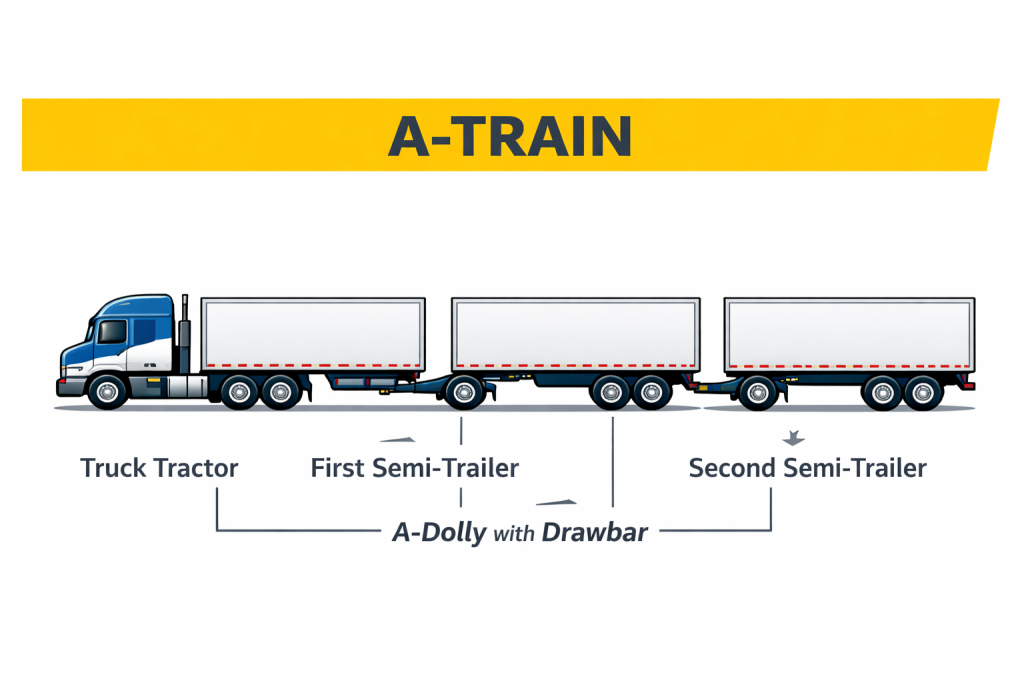
1. How an A Train Trailer Is Put Together
An a train trailer combination rolls with a tractor, a lead semi‑trailer, a converter dolly, and a second semi‑trailer.
The converter dolly carries its own axle or axles plus a fifth wheel, and it hooks to the back of the lead trailer with a drawbar or pintle‑type hitch.
This layout gives you three main pivot points: tractor to lead trailer, lead trailer to dolly, and dolly to second trailer. That means plenty of articulation when you’re moving.
2. Driving and Operating an A Train Trailer
Because an a train trailer has several pivot points, it can swing through tight turns but gets trickier when you’re backing up or making sharp low‑speed moves.
This setup works well when you need to bump up freight volume on routes drivers already know, where there’s enough space and the geometry makes sense.
Keeping it safe comes down to balanced loading, getting the brake settings right on that converter dolly, and running regular checks on tires, couplings, and safety chains.
III. B Train Trailer Configuration
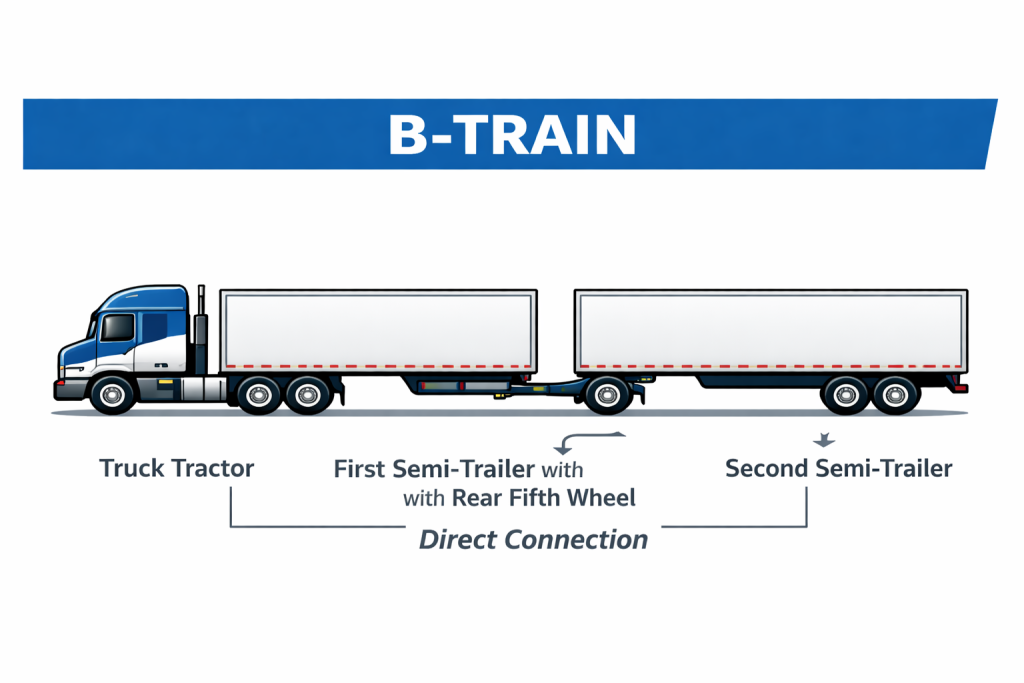
1. How a B Train Trailer Is Built
A b train trailer combination also runs two semi‑trailers, but the second one connects straight to a fifth wheel that sits on the rear of the lead trailer.
The lead trailer frame and axle group stretch rearward to hold up this fifth wheel, so you don’t need a separate converter dolly sitting between the trailers.
Many b train trailer rigs use multi‑axle lead and rear trailers to handle higher gross weights while spreading the load more evenly across all those axles.
Classic Application Cases in Africa: Dangler Trailer with Flatbed Trailer
2. Why Operators Go for B Train Trailer Setups
With fewer free pivot points than an a train trailer, a b train trailer usually gives you better straight‑line stability and more predictable lane tracking.
The tight connection and balanced weight spread help cut down the risk of trailer sway, rollover, and that dangerous “whip” effect during sudden steering moves.
For shippers and carriers, a b train trailer delivers high payloads with solid fuel efficiency and safety numbers, making it a go‑to choice for high‑capacity hauling.
IV. C‑Train Semi Truck Trailers
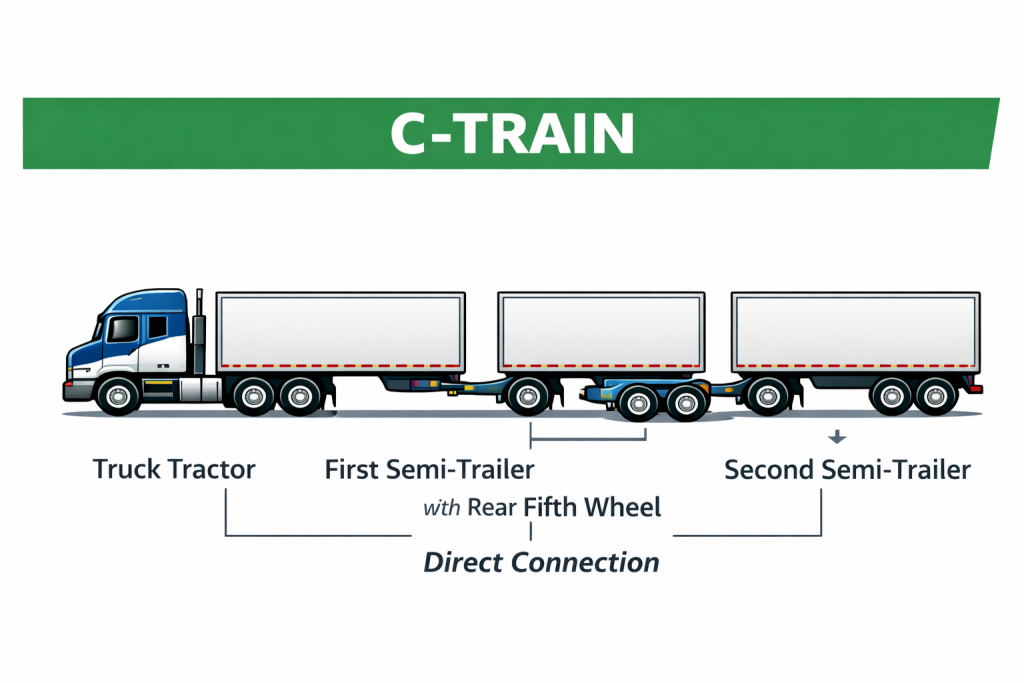
1. The Build of C‑Train Semi Truck Trailers
C-train semi truck trailers use a special C‑dolly that sits under the second trailer; the trailer rests on the dolly’s fifth wheel just like it would on a normal semi‑trailer.
The C‑dolly hooks to the lead trailer with two drawbars or a dual‑point connection, creating a stiff triangle between dolly and trailer.
Unlike the single‑drawbar dolly you see on an a train trailer, this dual‑link design removes one free articulation point and keeps that second trailer tracking close behind the first one.
2. Stability, Challenges and Where They’re Used
C-train semi truck trailers deliver rock‑solid stability for the second trailer, especially when you’re changing lanes or making sudden steering inputs.
The downside? The coupling system takes more work to connect correctly, and tight, low‑speed turns can chew up tires faster with all that scrubbing on the dolly.
Operators pick this type when they need the highest possible trailer stability and can handle the extra training and maintenance that comes with it.
V. Comparing A Train Trailer, B Train Trailer and C‑Train
1. Connection Systems and How They Handle
An a train trailer uses a converter dolly with a single drawbar, giving you maximum articulation but also the biggest chance of “snaking” if you don’t keep it under control.
A b train trailer joins the second trailer to a fifth wheel on the tail of the lead trailer, eliminating one pivot and boosting stability and handling at highway speeds.
C-train semi truck trailers depend on a C‑dolly with dual drawbars, which locks the dolly’s path to the lead trailer and gives you the most stable second trailer position you can get.
2. Picking the Right Setup for Your Operation
When you know your routes inside and out, space is tight, and you’ve got experienced drivers behind the wheel, an a train trailer can offer a solid mix of flexibility and carrying capacity.
For operations that need a balance between high payload and strong stability, plenty of fleets stick with the b train trailer for their regular line‑haul freight runs.
Where trailer stability has to be the top priority and you’re okay with the extra complexity, c-train semi truck trailers might be your best bet for moving heavy or sensitive loads.
By learning how an a train trailer, a b train trailer, and c-train semi truck trailers are put together and how they handle on the road, drivers and planners can match the right combination to their route, freight type, and safety goals.
LUEN: Your Partner for Heavy-Duty Trailer Solutions
When you’re ready to build or upgrade your truck train fleet, LUEN offers a complete range of heavy-duty semi-trailers, dolly trailers, and drawbar trailers engineered for a train trailer, b train trailer, and c-train semi truck trailers configurations. Every LUEN trailer is built with reinforced frames, precision-engineered coupling systems, and premium components designed to handle maximum loads safely and efficiently. With decades of experience in heavy-duty trailer manufacturing, LUEN understands what it takes to keep your operations running profitably while meeting the strictest safety standards. Whether you need a single-axle dolly trailer for terminal runs or a multi-axle heavy-duty semi-trailer for long combination vehicles, LUEN has the equipment and expertise to support your hauling needs.


