English
 Spanish
 French
Everything You Need to Know About Step Deck Trailers: Features, Benefits, and Comparisons
Introduction
Step deck trailers, or drop deck trailers, carry oversized cargo. They can handle loads taller than standard flatbed trailers allow. Their unique feature is the lower deck. It drops down after the front wheels. This gives more vertical space for taller loads. These trailers are widely used across industries such as construction, agriculture, and manufacturing.
What is a Step Deck Trailer

A step deck trailer is a specialized type of semi-trailer with two distinct deck levels:
-
The upper deck, typically about 5 feet high, located above the tractor’s fifth wheel.
-
The lower deck, which drops down to about 3 feet 6 inches, creating a “step” between the two decks.
This setup lets taller loads, such as construction machinery and big industrial equipment, be legally transported. Standard flatbed trailers can’t handle these loads because of height limits. Stepdeck trucks are equipped with ramps or drop sections for easier loading of wheeled equipment, such as tractors or cranes.
What Is the Difference Between Step Deck and Drop Deck?
The terms step deck and drop deck are often used interchangeably. Both refer to trailers with a lower deck to accommodate large items and taller cargo, while also adhering to a weight limit. The difference is in the drop design. A step deck has a clear “step” between the upper and lower decks. A drop deck is a type of trailer that lowers right after the front wheels. This design depends on specific specifications.
Common Freight Transported on Step Deck Trailers
-
Construction Equipment: Excavators, bulldozers, cranes, and backhoes.
-
Agricultural Machinery: Tractors, combines, balers, and irrigation systems.
-
Industrial Materials: Steel beams, oversized pipes, lumber.
-
Vehicles: Shipping containers, boats, and RVs.
-
Other Irregularly Shaped Cargo: Oversized or heavy items requiring extra height clearance.
Step Deck Trailer Dimensions and Weight Capacity
Step deck trailers typically have the following dimensions:
-
Width: 8 feet 6 inches.
-
Length: Standard lengths include 40, 48, and 53 feet.
-
Height Capacity: The lower deck can accommodate cargo up to 10 feet tall (varies by trailer and jurisdiction).
-
Weight Capacity: Up to 48,000 pounds, depending on the axle configuration.
Step deck trailers are versatile but may require special permits for particularly heavy or oversized loads.
Step Deck vs. Flatbed Trailers
|
Feature |
Lower front deck (3’6”), upper deck (~5’) with lower deck height considerations | Flatbed Trailer |
|---|---|---|
| Deck Height | Lower front deck (3’6”), upper deck (~5’) | Single deck about 5’ |
| Cargo Height Capacity | Taller loads (up to 10 feet) | Limited height capacity |
| Loading Method | Ramps or drop sections | Dock-level loading |
| Use Cases | Oversized, tall loads |
Large but not tall loads |
Step deck trailers are ideal for transporting items that exceed the height limits of flatbed trailers but don’t require the low profile of a lowboy trailer.
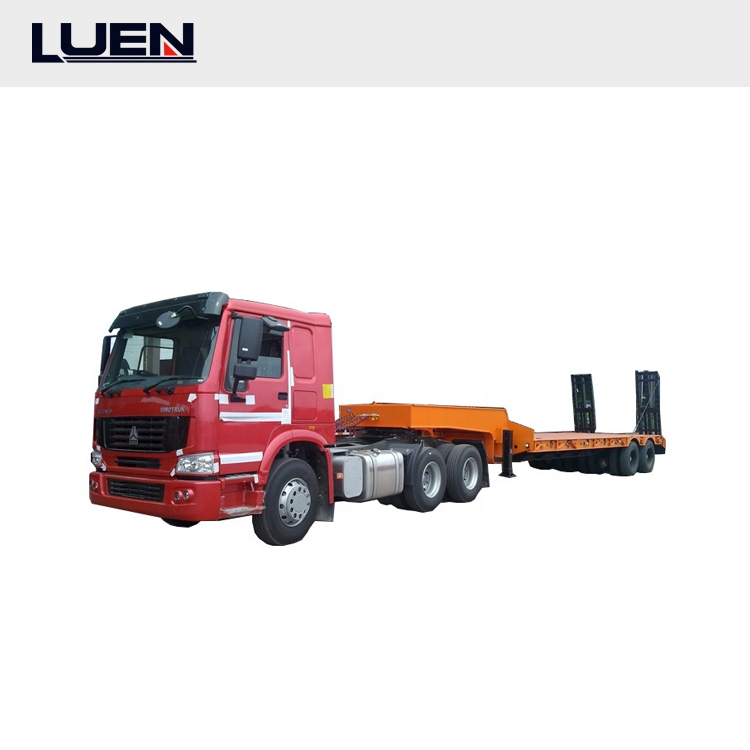
Step Deck vs. Lowboy Trailers
|
Feature |
Step Deck Trailer | Lowboy Trailer |
|---|---|---|
| Deck Height | Two-level deck with step (~3’6” lower deck) | Very low deck, close to the ground |
| Cargo Height Capacity | Medium to tall cargo | Extremely tall or heavy cargo |
| Loading | Ramps or drop sections | Extremely low deck facilitates loading of heavy machinery |
| Cost | More versatile and cost-effective |
Specialized and often more expensive |
Lowboy trailers are designed for extremely tall or heavy cargo but require more specialized permits and can be more expensive.
Related:Step-Deck vs Lowboy Trailers: A Detailed Comparison
Step Deck vs. RGN Trailers
| Feature | Step Deck Trailer | RGN Trailer |
|---|---|---|
| Deck Height | Two-level deck with step (~3’6″ lower deck) | Removable gooseneck with extremely low deck |
| Cargo Height Capacity | Medium to tall cargo | Extremely tall and oversized cargo |
| Loading | Ramps or drop sections | Detachable front section allows drive-on/roll-on loading |
| Weight Capacity | Up to 48,000 lbs typical | Up to 150,000+ lbs |
| Cargo Types | Construction equipment, machinery, vehicles | Heavy industrial equipment, transformers, large machinery |
| Setup Complexity | Standard hookup and loading | Requires detaching gooseneck for loading |
| Permits Required | Standard oversize permits when needed | Often requires special routing and escort vehicles |
| Cost | More versatile and cost-effective | Specialized and significantly more expensive |
RGN (Removable Gooseneck) trailers are designed for the heaviest and tallest cargo but require specialized handling, permits, and routing, making them considerably more expensive than step deck trailers.
Conclusion
Step deck trailers are an essential tool for industries requiring the transport of tall and oversized cargo. Step deck trailers have pros and cons. They can meet height restrictions. They also make loading and unloading easy. This versatility makes them a cost-effective choice. A step deck trailer is perfect for moving construction equipment, farm machinery, or industrial materials. It offers the flexibility you need for your shipping tasks.
FAQ
Is There More Than One Type of Step-Deck Trailer?
Yes, there is more than one type of step-deck trailer! Step-deck trailers, or drop-deck trailers, have gooseneck designs. You can load them on the front or back. This flexibility helps fit various types of cargo. The most common types include:
1. Standard Step-Deck Trailers: These have two levels – a higher front deck and a lower rear deck. They are ideal for transporting taller loads that can’t fit under standard height restrictions.
2. Double Drop Step-Deck Trailers: They have two drops. This makes the middle section lower than standard step-decks. This design is perfect for very tall loads, like construction equipment.
3. Lowboy Trailers: Lowboys are not the same as step-decks, but they often come up in discussions. They have a low deck height and are great for transporting heavy machinery.
Each type serves specific purposes based on cargo needs, weight restrictions, and height requirements. So when it comes to step-deck trailers, there’s definitely some variety to choose from!
Why is the lower deck height important?
The lower deck height is important for several reasons, particularly in the context of transportation and design. Firstly, it enhances accessibility, making it easier for people to board and disembark from vehicles such as buses or trains. A lower deck height boosts stability and lowers the center of gravity. This change makes handling and operation safer, especially for larger vehicles. In architecture and urban planning, a lower deck height can help blend with the surroundings. This creates more welcoming public spaces. Overall, it’s all about enhancing safety, comfort, and usability!