English
 Spanish
 French

Step-Deck vs Lowboy Trailers: A Detailed Comparison
Every day, transportation professionals face critical decisions that can make or break their shipping operations. When your cargo exceeds standard flatbed height limitations, the choice between step deck and lowboy trailers becomes a pivotal factor in project success.
In today’s freight transportation industry, selecting the appropriate trailer configuration directly impacts your operational efficiency, cost management, and regulatory compliance. The complexity of modern logistics demands precise equipment matching to cargo specifications.
When dealing with tall and heavy freight requirements, two primary trailer configurations dominate the market: step deck and lowboy trailers. Understanding the fundamental differences between these specialized equipment types becomes essential for making informed transportation decisions that align with your operational objectives.
This comprehensive analysis examines what constitutes a step deck trailer, provides detailed comparisons with lowboy trailer capabilities, and delivers authoritative insights into their applications, dimensional specifications, and cost implications. Our discussion encompasses critical considerations for step deck vs lowboy selection, low boy operational parameters, low trailer configurations, step deck semi trailer specifications, and related equipment decisions that influence your transportation strategy.
What is a Step-Deck Trailer?

LUEN Step Deck Trailer
A step deck trailer represents an evolution in flatbed trailer design, engineered to provide enhanced height clearance through strategic deck configuration. Also recognized in the industry as a drop deck trailer, this equipment type features a distinctive two-level design approach.
The trailer incorporates an elevated front deck section that maintains compatibility with standard tractor configurations, while the rear section drops to a lower elevation, creating the characteristic “step” profile. This design positions the deck height at approximately 3 feet 4 inches (40 inches) from ground level at its lowest point, establishing a maximum cargo height capacity of 10 feet 2 inches before over-dimensional permitting requirements take effect.
Standard step deck configurations typically measure 48 or 53 feet in overall length, providing substantial cargo capacity for diverse freight requirements.
Step deck trailers demonstrate exceptional versatility across multiple freight categories, effectively handling construction materials, industrial machinery, and vehicular cargo. When weather protection becomes necessary, a tarped step deck trailer configuration maintains cargo integrity while preserving operational flexibility.
The fundamental advantage over traditional flatbed configurations lies in the lowered rear deck design, which enables legal transportation of taller cargo loads without triggering over-dimensional regulatory requirements.
Related:Everything You Need to Know About Step Deck Trailers: Features, Benefits, and Comparisons
What is a Lowboy Trailer?

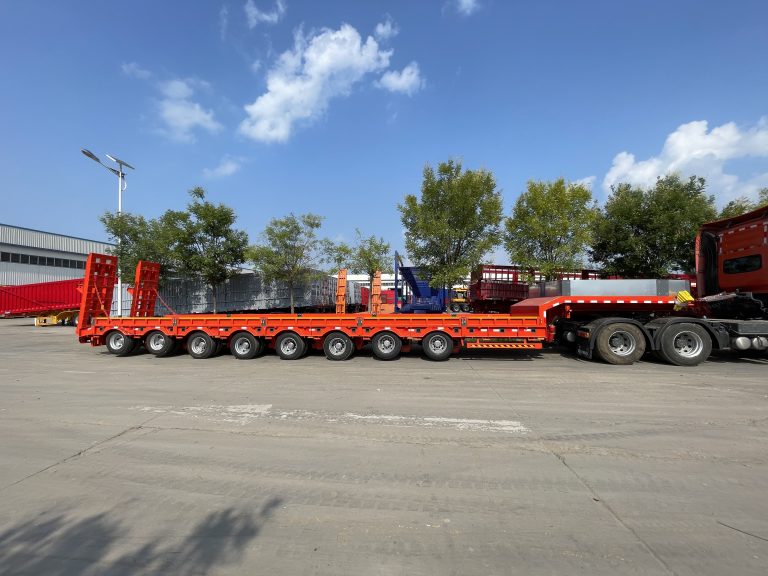
LUEN Lowboy Trailer
The lowboy trailer represents the most specialized solution for extreme height and weight transportation requirements. Industry professionals also refer to this equipment as a low bed trailer or low loader, reflecting its primary design characteristic.
This trailer configuration positions the cargo deck significantly closer to ground level than alternative options, typically maintaining 18 to 24 inches of ground clearance. The ultra-low deck positioning enables accommodation of exceptionally tall freight, supporting cargo heights up to 11 feet 6 inches under standard legal limits.
The lowboy design incorporates a central well-space that typically measures between 25 to 30 feet in length, constrained by structural drops positioned behind the gooseneck connection and ahead of the rear axle assembly.
Lowboy trailers are purpose-built for transporting oversized industrial equipment, including excavators, bulldozers, and massive machinery installations that exceed conventional trailer capabilities.
Many lowboy configurations feature removable gooseneck (RGN) capability, allowing the front section to detach and create an integrated loading ramp. This design eliminates crane requirements for self-propelled equipment loading and unloading operations. This feature becomes particularly relevant when evaluating RGN vs stepdeck trailer options for specific cargo requirements.
Key Differences Between Step Deck and Lowboy Trailers
Professional transportation planning requires understanding the fundamental distinctions between these trailer configurations:
Deck Configuration and Elevation: Lowboy trailers maintain a single, continuous low-profile deck, while step deck trailers incorporate dual-level deck configurations. Step deck lower sections maintain approximately 40 inches of ground clearance, compared to lowboy positioning at 18 to 24 inches above pavement level.
Height and Weight Specifications: Step deck trailers accommodate cargo heights up to 10’2″ with standard weight capacities of approximately 46,000 pounds using 2-axle configurations. Lowboy trailers support taller cargo up to 11’6″ while handling substantial weight ranges from 40,000 to 80,000 pounds, depending on axle configuration requirements.
Loading Methodology: Step deck trailers typically incorporate fixed ramp systems for drive-on/drive-off operations. Lowboy trailers, particularly RGN configurations, provide detachable gooseneck functionality that creates integrated loading ramps, facilitating heavy equipment positioning without external lifting equipment.
Operational Costs: Lowboy trailers require specialized operational expertise, including experienced drivers trained in complex cargo securement protocols. This specialization typically results in higher operational costs compared to step deck or conventional flatbed alternatives.
Application Versatility: Step deck trailers offer broader application flexibility, effectively serving diverse cargo types under height limitations of 10’2″. Lowboy trailers provide specialized capabilities for oversized and heavy equipment transport but demonstrate limited versatility for general freight applications.
Uses and Limitations
Step Deck Trailers
Step deck trailers excel in applications involving freight that exceeds flatbed height limitations while remaining within the 10 feet 2 inches maximum threshold. Primary applications include construction materials such as lumber and structural steel, agricultural equipment transportation, and crated industrial machinery requiring additional height clearance.
Step deck flatbed configurations accommodate tarp coverage for weather-sensitive cargo protection, maintaining load integrity during transportation.
Operational Limitations: The height restriction of 10’2″ represents an absolute constraint for step deck applications. Cargo exceeding this dimension requires alternative trailer solutions. Additionally, loading operations may require elevated dock facilities or specialized ramp equipment for heavy machinery handling.
Lowboy Trailers
Lowboy trailers demonstrate superior capability for oversized and heavy industrial equipment transportation, including bulldozers, large tractors, and industrial machinery installations. The ultra-low deck profile accommodates cargo up to 11 feet 6 inches in height, making these trailers essential for lowboy overdimension freight requirements that exceed step deck limitations.
Operational Constraints: The specialized nature of lowboy operations results in higher operational costs and reduced availability. The limited well-space of 25 to 30 feet restricts cargo length capacity, requiring careful dimensional analysis before equipment selection.
Step Deck vs RGN (Removable Gooseneck)
Understanding the distinction between step deck and RGN trailer is crucial for optimal equipment selection. Step deck trailers feature fixed two-level deck designs with integrated ramp systems, providing reliable and straightforward loading capabilities.
RGN configurations offer detachable gooseneck functionality that transforms into loading ramps, enabling direct drive-on access for self-propelled equipment without requiring crane assistance. RGN trailers typically represent a specialized subset of lowboy trailer configurations, becoming essential when cargo loading demands ramp access while crane availability remains limited.
Summary Table
| Feature | Step Deck Trailer | Lowboy Trailer |
|---|---|---|
| Max Height Capacity | 10 ft 2 in | Up to 11 ft 6 in |
| Deck Height Above Ground | ~40 inches | 18-24 inches |
| Typical Weight Capacity | ~46,000 lbs (2 axles) | 40,000 – 80,000 lbs (more axles) |
| Typical Deck Length | 48-53 ft combined upper & lower decks | Well-space 25-30 ft |
| Loading Method | With ramps | With removable gooseneck (RGN) ramps |
| Versatility | More versatile for mixed loads | Specialized for heavy, tall equipment |
| Cost | Lower | Higher |
Conclusion
Strategic trailer selection requires comprehensive analysis of cargo specifications against equipment capabilities. For freight shipments under 10 feet 2 inches in height with moderate weight requirements, step deck trailers provide optimal cost-effectiveness and operational flexibility.
When cargo requirements involve oversized heavy equipment or height dimensions approaching 11 feet 6 inches, lowboy trailer or RGN configurations become necessary, delivering the specialized height clearance and loading capabilities required for successful transportation, despite higher operational costs.
The decision between step deck vs lowboy configurations depends entirely on specific cargo height, weight, and dimensional requirements. Professional understanding of step deck max height limitations, lowboy trailer dimensions, and appropriate loading methodologies ensures compliant, safe, and cost-effective freight transportation solutions.
Proper equipment selection represents the foundation of successful transportation operations, directly influencing project timelines, regulatory compliance, and overall operational efficiency.
Choose LUEN for Your Trailer Solutions
At LUEN, we understand that having the right trailer equipment is essential for your transportation success. We offer a comprehensive selection of high-quality step deck trailers and lowboy trailers designed to meet the demanding requirements of today’s freight industry.
Our step deck trailer inventory features reliable configurations optimized for versatile cargo handling, while our lowboy trailer selection includes specialized heavy-haul solutions with RGN capabilities. Each trailer in our fleet is maintained to the highest industry standards, ensuring your cargo reaches its destination safely and on schedule.
Whether you need the flexibility of a step deck semi trailer for mixed freight operations or the specialized capabilities of lowboy trailers for oversized equipment transport, LUEN provides the professional-grade solutions that keep your operations moving forward. Contact us today to discuss your specific trailer requirements and discover how our equipment can enhance your transportation capabilities.